It's been a while since I've blogged. Below is an article to be published next week in The Christian Century. Just to be safe, I've posted my original submission here, which was shortened and edited a bit for the publication.
I learned to install a door on an ordinary weekday in small town Arkansas. The house was a nondescript tract home, whose pinkish, mottled brick was dated before the mason finished his work. The door was an equally uninspiring metal unit from the lumberyard, to be installed at the house’s main entry. It had been delivered to the site already hinged and hung in its jamb.
In a matter of minutes, my boss, Dave, had given me all the information I would ever need to install a door. He told me how to make sure the studs on the hinge side of the opening were plumb in two directions, tacking up shims to correct for the framers’ hurry. He explained to me that a push on a corner in one direction would effect a movement in another. All I had to do was fill the framed opening with the door, making all things plumb and flush.
When he returned an hour and a half later, Dave was clearly, but politely, surprised that I was still struggling at my task. I had all the information I needed, but when put into practice that seemingly rigid object behaved like a balloon in my inexperienced hands. A push to its here bulged its there wildly. A butterfly of a shim tap created a whirlwind of chaos in a faraway place on the door.
Dave stepped in, gave a few knowing bumps and shoves, and in a matter of moments, all was right with the door.
There are different kinds and loci of knowing. And the goal of any apprenticeship is an accumulation of knowledge in the hands. No explanation is required other than the properly fit thing: the flush door, the mitered corner. Things visibly meet and right.
Some traditions place a great deal of value on religious information. Accordingly, the Christian faith is measured in a quick tally of doctrinal positions. Real Christians are called ‘believers’ perhaps, a term that suggests the possession of some essential and accurate information about God.
I grew up in one such tradition. Our information happened to come from methods and sources embraced by the right end of the religious spectrum. The left had and has their methods and sources as well.
But even though I couldn’t have said so at the time, a hunch was growing that my knowledge of the faith wasn’t making its way into some terribly important parts of my self. I still felt like that clumsy apprentice with plenty of information in his head, but whose hands remained ignorant and inadequate.
Liturgical worship assumes that bodies must learn too. It’s not enough to fill one’s mind with an orthodox collection of facts—whether established by pope, prophet, or sacred text. Something happens, something is communicated to and into our selves when we bow, stand, kneel, sing, and process together. Colors and smells and even the arrangement of furniture deliver information to different parts of our selves.
So might we begin to imagine our hands, knees, noses, bellies, our bodies as curious? As seeking? As wanting to know something of the mystery of God as surely as our minds do?
When Christians read the insistence in James that “faith without works is dead”, we tend to understand works as expressions of faith. Faith is an interior reality that can and should make its way to the surface of a life. But what if more attention were paid to the way that “works”, the concrete actions of bodies in the world, infect faith with life? What if we understood the work we do—thinking here of liturgy, “the work of the people”—in terms of formation more than expression?
Even conspicuously liturgical traditions can ignore or deny liturgy as a means of formation. Gestures and movements are easily employed as secret handshakes, signs that someone carries the right information about how to worship. “Did you see that guy make (or fail to make) the sign of the cross at the
Benedictus Qui Venit? Clearly he’s not one of us,” the thinking goes, whether we think the response all the way into words or not.
But more and more people are coming into church blessedly oblivious to the right liturgical answers once agreed upon in their high, low, evangelical, Anglo-Catholic, or broad church congregations. And these people bear a particular gift to the gathered assembly: They simply haven’t learned to read the signals.
The newness of the gestures and motions, perhaps even the clumsiness with which they are first employed reminds us all that sometimes grace is out at our fingertips first. It may take time and motion to settle inward.
Liturgical converts are naturally open to the possibility that liturgy isn’t meant to express who we are so much as it’s meant to transform who we are. Liturgical actions need not function as encoded messages, meant to mark out theological territory nor are they flashy vehicles meant to transport speakable doctrines to our heads. Such actions change us, because we are people who not only think thoughts about God, but who live and move and have our being in God. And the movement of our bodies is an irreducible, irreplacable way of knowing.
So maybe the liturgy is helpfully thought of as a door. Not as a portal to be walked through into someplace else. But a door like the one I struggled with all those years ago as a carpenter’s apprentice. For the transformation worked or wreaked by the liturgy is bodily. We lean into the mystery here and discover something moves there, our bodies learning, learning all the while. Maybe the liturgy itself is the sturdy thing my body is meant to struggle with until its wisdom makes its way into my hands, into my belly, into my bones.
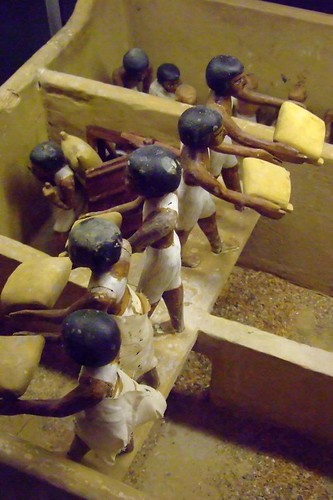 Then, on Saturday, I saw a little model granary sent along with the Egyptian dead to ensure the provision of food in the next life. And those ancient villains and I became friends of a sort.


 Posts
Posts

