Wednesday, May 12, 2010

The Real


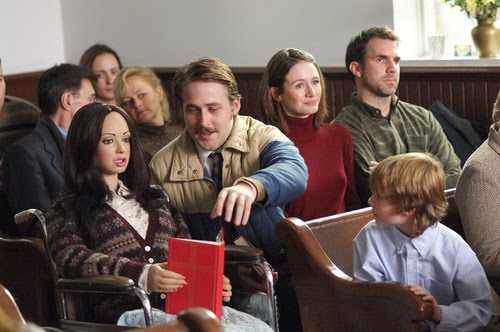
We finally got around to watching Lars and the Real Girl. This is one of those movies about which one probably shouldn't hazard a synopsis. But it's about a guy named Lars and the life sized mail order doll named Bianca who becomes his girlfriend.

Lars, I probably don't need to tell you, is delusional. But the movie is a cinematic wondering about whether a delusion might be a community matter more than one person's pathology. Lars's community decides to accept his delusion, holding out the possibility that Bianca is a symptom of something collective, something amiss, awry, or at least something at work in the life of a family, a church, a town.

But I think the movie is also about how we're made real. It's something of a Velveteen Rabbit without the miracles. In The Velveteen Rabbit, you may remember, toys are made real by the love of a child. And 'real' means that they live and breathe and hop off into the forest under their own volition. But as Lars's community pretends that Bianca is real (eventually they elect her to the school board) we sense that none of us may begin real. Perhaps we're made real by others.

Descartes said, "I think, therefore I am." And we (in the West, at least) haven't looked back. We've taken his statement as a self evident truth that reality is an individual matter.

But theologian John Zizoulas once wrote that "one person is no person". In fact, in Being as Communion, Zizoulas lays out the mysterious Christian doctrine of the Trinity as an acknowledgment that God is one, but God is not an individual. There is community within God's very self.

This is heavy stuff. But it's heavy stuff that matters, I think. It mattered to the little Minnesota town where Lars lived. In making Bianca real, everyone was made a little more real.

After Bianca's burial Lars asks Margo to go for a walk. She's been in love with Lars all along. But even though its Lars who no longer feels human touch as pain, even though it's Lars who no longer lives alone in the garage, even though it's Lars who let's go of his mail order girl, it's not just Lars who gets real. Lars is as involved in making people real as he is in becoming real.

What if being really is communion, not just for God, but for us? What would change in our families and churches and towns if we believed that we're only and always made real in communion?

Believing such a thing would mean that the real "real girl" in a movie might well be harder to spot (is it Bianca or Margo?). But believing such a thing might radically change the way we conceive our politics, our families, and ultimately our selves.

What if my only truly inalienable, self evident right is to be in communion? What if?

Wednesday, April 7, 2010

An Easter Sermon

The folks in our house are not fast food fans. Maybe it was the viewing of Supersize Me that we inflicted on our kids in their formative years that did it. But a couple of weeks ago we were trying to get out of town for a camping trip, and we found coupons for a free Jamocha shake with the purchase of any sandwich. So, adventurous souls that we are, we risked a stop at the Arby’s drive through window.

Maybe it’s that relative lack of recent experience with this food that made the encounter so surprising and unsettling for me. But along with the first unappetizing bite of my Market Fresh turkey sandwich came this curious hypothesis: I think that the people who name fast food sandwiches are the same people who name housing subdivisions.

Here’s what I mean. It was obvious that nothing in my Market Fresh sandwich was either purchased at any kind of market or fresh by any reasonable standard. Even the pepper seemed to leave a sort of antiseptic aftertaste. No, the sandwich’s name seemed to have nothing to do with the sandwich itself. It was named to appeal to people who like words like “market” and “fresh”. People who think these words sound nice. People who like these words might just buy a sandwich called “market fresh”. They do, and I did.

Wouldn’t you agree that this must be the work of the subdivision namers? You might live in a pleasant place called something like Timber Cove, even though the trees were all bulldozed and replaced with a few sad little saplings when the first road was cut. And the fact that your neighborhood is named something “Cove” or “Valley” or “Ridge” may or may not have anything at all to do with actual geographic features of the land.

This is the brave new postmodern world we were warned about. A world in which our language is emptied of real meaning. A world in which words might mean anything and are chosen more to make us feel some way rather than to point us toward something real, something sturdy, something true.

The stakes aren’t so high when we’re talking about sandwiches and subdivisions. But what if we’re talking about words like “Christian”. What if we’re talking about a word like “Jesus”? What are we to do if we wake up one day and the reality we thought our religious language pointed us toward is gone?

This sounds like a modern dilemma. But it’s at least as old as Easter. Because by Sunday morning, for Mary Magdalene even the name Jesus must have felt kind of hollow; it must have sounded a little foreign perhaps. All the hopes and expectations it had once been filled with were gone, emptied out completely on Good Friday. Maybe the word itself went suddenly strange. As though she’d read it for the first time that morning on a billboard, or a license plate, or the belt buckle of an odd stranger in the park.

You know the feeling, don’t you? Especially after the death of someone we love, the most familiar sights and sounds go a little strange. Everything hangs in a sort of obscuring fog that makes us wonder how we ever felt safe and at home in this world and makes us wonder how we ever thought names and words would mean something sure forever.

And countless people across time have had a similar experience with regard to their faith. Mary’s not the only one for whom the Jesus we thought we knew dies or disappears or just becomes strange. We thought Jesus answered all our prayers just so, watched out for our loved ones, pricked our consciences in reliable ways. Then one day that Jesus is gone. The people on television or on the bestseller lists or in the pulpit keep using his name, but the person they describe has less and less to do with any God we’ve actually encountered or any savior we’ve honestly longed for in a long, long time.

Once upon a time we believed. Once upon a time Christianity held meaning, and Jesus was the name of someone familiar and comprehensible. Once upon a time…

Sometimes in such moments of doubt we might push back a little. We might appropriate the methods of the sandwich and subdivision namers for a higher purpose. We might try to fill the vacant old religious words with the meaning we want them to hold and try to imagine a Jesus we might actually hope for into being. But the approach doesn’t work for long, because we sense that imagining a Jesus we want into existence, no matter how appealing he might be, is just another fraud, a short postponement of more disillusion.

Mary, at least, grieved honestly. Early on the first Easter morning she had begun imagining her way toward a future without Jesus, and she didn’t hope for much. She saw the empty tomb, but even with two angels in white framing the emptiness where the body had been, Mary thought it must have been stolen, and she begged only for the chance to treat that precious corpse with the dignity it deserved. But it was gone. And what other explanation, what other future could there be? It’s not the outcome she had hoped for, but how else could she make sense of it all?

All Mary knew to do that morning was visit the tomb. But Mary also lingered there for a while. And she lingered there long enough to hear her name. She didn’t solve the riddle, read the signs, comprehend the prophecy. The meaning of Jesus has been so completely lost that when Mary meets the risen Christ in the garden, she doesn’t know him. Which is one way the gospel writer tells us that Mary didn’t get the Jesus she was looking for. But when Mary hears her name, her eyes are opened.

For some of us, the Christian faith is a lot like lingering at a tomb. We’re not quite sure what else to do, so maybe we keep on using the old Christian words long after they’ve ceased to hold much meaning. Maybe we even keep coming to church. But for some of us, it’s only after we’ve stopped expecting to encounter the old Jesus at all that the risen Christ appears and calls to us. It’s only when we’ve let go of everything we think we’re supposed to do or think or believe to be properly religious that we encounter the living God who actually knows us and calls us by name. For us, as for Mary, faith is a gift.

The problem, of course, is that Mary wasn’t in control, which suggests that we may not be in control of this encounter either. Mary didn’t summon Jesus or figure out how to entice him. He just showed up. But after his questions, Jesus does offer Mary one simple instruction. He demands just one action. Almost as soon as Jesus speaks Mary’s name, he says, “Do not hold on to me.” The only thing he tells her to do is “Don’t cling.”

Could it be that for us as for Mary, the impulse to cling to the Jesus we think we know—no matter how bereft of meaning that Jesus has become—could it be that this impulse to cling is what keeps us from seeing the risen Christ who is actually among us? Who may actually be calling to us by name? Clinging to Christianity as we assume it must be—whether we cling in order to dismiss it or to fill it with our own made up meaning—clinging to Christianity as we assume it must be, might be what keeps us from a living faith that can actually fill our empty lives and direct them toward a future with God.

“Do not hold on to me,” said Jesus. And we should remember that he was telling Mary not to cling even to the risen Christ. Even after the resurrection, clinging too desperately to the Christ of that day might keep Mary from following the Christ who was calling her into the next. Even on Easter morning, he said, “Mary, don’t hold on.”

Might Jesus’ instructions be relevant to us and to our Christian tradition today? The great gift of our Anglican heritage is surely our generous but grounded understanding of worship and the sacraments. Because if we approach these holy mysteries without clinging to our notions and assumptions about what God must surely mean by them or what we think God will surely do to us through them, when we approach these holy mysteries open to a new experience of the loving God who creates and redeems and sustains us, we open ourselves to transformation.

And maybe when we learn to live this way as a church, we will stop clinging to the hollow shell of the Jesus we think we know or the fleeting Jesus we have wished into being for a time—whether he was liberal or conservative or orthodox or radical—maybe we will stop clinging, and linger honestly at the tomb and see just who it is that calls our name today.

For maybe it’s precisely when the language of faith goes a little strange, when the sights and sounds are a little less familiar, when the meaning of Jesus is no longer so settled and obvious, that resurrection is close at hand. Amen.

Wednesday, March 31, 2010

The Way of the Cross

Here's a story told by Wendell Berry in an essay called, "The Burden of the Gospels":
"In 1569 in Holland, a Mennonite named Dirk Willems, under capital sentence as a heretic, was fleeing from arrest, pursued by a ‘thief-catcher.’ As they ran across a frozen body of water, the thief-catcher broke through the ice. Without help, he would have drowned.

What did Dirk Willems do then? Was the thief-catcher an enemy merely to be hated, or was he a neighbor to be loved as one loves oneself. Was he an enemy whom one must love in order to be a child of God? Was he ‘one of the least of these my brethren’? What Dirk Willems did was turn back, put out his hands to his pursuer and save his life. The thief-catcher, who then of course wanted to let his rescuer go, was forced to arrest him. Dirk Willems was brought to trial, sentenced, and burned to death by a ‘lingering fire.’

I, and I suppose you, would like to be a child of God even at the cost of so much pain. But would we, in similar circumstances, turn back to offer the charity of Christ to an enemy?"
What's stunning about Holy Week isn't just that it happened, but that it happens again and again in this world. And the question is, just as it is for the pacifist witness of Dirk Willems, "does it work?"

From our perspective, Willem's charity didn't work out for him. But our definition of a life's working out well is probably closer to Spock's than Jesus's. "Live long and prosper" we get. "Love your enemies and pray for those who persecute you," ...not so much.

Like Wendell Berry, I can't say that I would respond like Dirk Willems. I can't even manage to forgive the enemy who simply slanders or mistreats my ego in the mildest of ways. And I can easily construct a situation in my mind in which the pacifist witness would look less noble, or at least more complicated. But the truth is that Jesus' silence this week before his accusers is not some literary flourish to this story.

Jesus refused to return evil for evil, violence for violence, even when it meant his crucifixion. He taught us to do the same. Yet radical peaceableness toward enemies was explained away so long ago by most Christians that we rarely let the notion cramp even our emotional state. The righteous hatred and embrace of retributive justice by Christians are taken as matters of fact, by the world and by us Christians ourselves.

All I ask is that we listen honestly to the story that will unfold this Triduum, these three sobering days. And ask the question, "This way of Jesus, this way of the cross, did it work? Does it work?"

The answer probably comes down to whether I will let Jesus' way go to work on me.

Tuesday, March 16, 2010

Ignorance and Bliss

"Since we're billions of times more ignorant than knowledgeable, why not go with our long suit and have an ignorance-based worldview?"

- Wes Jackson in The Virtues of Ignorance: Complexity, Sustainability, and the Limits of Knowledge
Did you know about the Google calculator? If you type in a math problem into Google, you'll get the answer above the several million search results. This doesn't sound very impressive, since your old Texas Instruments calculator did the same thing back in 1980. But if you Google "answer to life, the universe, and everything" the Google calculator will answer "42". Try it.

Douglas Adams fans will appreciate this playful little quirk in the great search engine, as the answer to the meaning of life, the universe and everything does, in fact, turn out to be 42 in Adams's Hitchhiker's Guide to the Galaxy series.

Google's California headquarters is named the "Googleplex", a nod to the "Googleplex Star Thinker in the Seventh Galaxy of Light and Ingenuity which can calculate the trajectory of every single dust particle throughout a five-week Dangrabad Beta sand blizzard?" (again, see The Hithhiker's Guide to the Universe).

It's heartening to me that the folks at Google have a sense of humor. Because in the age of Google, it may be more important than ever to remember that the calculable answer to the meaning of life, the universe and everything might just be something like 42. Put another way, we're increasingly amazed at how much we know and how accurate our knowledge is becoming. But we don't always stop to ask whether we can still find meaning in all that data.

Wes Jackson is a farmer and agricultural scientist. And the quote at the top of this page contrasts pretty sharply with googlization. It suggests that we might not be any closer to the truth about our selves and our world if we had a real Googleplex Star Thinker. And Jackson suggests that a respect for all we don't know is as crucial as the accumulation of information.

The book of Proverbs puts it this way:
"Trust in the Lord with all your heart,
and do not rely on your own insight.
In all your ways acknowledge him,
and he will make straight your paths.
Do not be wise in your own eyes;
fear the Lord, and turn away from evil."

That sounds like quaint, out of date wisdom from an age of inadequate information. Human insight has gotten us mighty close to the Googleplex that was science fiction humor a few decades ago.

But the stuff of tragedy is the same as it was in Homer's time and before. Hubris is ever the enemy. The prideful certainty that we can know enough is still our downfall. We are oh so wise in our own eyes, but are we happy? Are we whole? Can we still make a mess of things?

Trusting in God and acknowledging God are ways that we humans have embraced our ignorance. While we Christians believe that God has disclosed God's very self to us, God is not a problem to be solved by the Googleplex. God is a mystery that grows thicker, richer, deeper with every encounter. And, ironically, it's only in our acknowledgment of the realm and the One we know almost nothing of, that what we do know takes on meaning.

Without the reclamation of an ignorance-based world view we may never learn to use the information we've Googled well.

Tuesday, March 9, 2010

A Bottle o' Mystery

"God did not become a movement, a concept, an ideal, or even a committee, but a man of flesh and bone with a parentage, friends, a language, a coutry, a home. He inhabited not just a time but places, streets, rooms, countrysides, and by his presence in the flesh he changed them all."

- Aidan Kavanagh, Elements of Rite

I heard on the radio this morning that a woman recently auctioned a glass bottle containing two ghosts for $2000. This is a great mystery.

The mystery, however, isn't about the contents of the bottle. The woman's the mystery. And I don't mean she's a mystery because she's crazy enough to believe in bottling ghosts. It's just that a thing (a person being some-thing rather than no-thing) is a far greater mystery than a concept. That's why wondering about whether ghosts exist is nothing like wondering at the mystery of a real person who gets out of bed on a particular morning in March and decides to sell her bottled ghosts on Ebay.

Today is Gregory of Nyssa's feast day. And in the fourth century, he wrote, "Concepts create idols; only wonder grasps anything."

Gregory of Nyssa and Aidan Kavanagh (the fellow quoted above) share a suspicion of our preoccupation with concepts, with disembodied ideas. And they both believed that God changed and changes us less through notions than with bodies. The incarnation isn't a concept. It's "a man of flesh and bone with a parentage, friends, a language, a coutry, a home."

Christian theology often seems to be about carrying around proper concepts about God in our heads. I love the struggles and arguments that these concepts have stirred up over the centuries. But the concepts are the ghosts in our bottles. They have a lot to do with who we are, but we're what's real, and it's us that God's at work in and on and through.

This is why Aidan Kavanagh cared so passionately about liturgy. Liturgy is a way of doing theology. Liturgy isn't a concept. Liturgy is always embodied. Liturgy is always about bodies and buildings and furniture, things seen and smelled and heard. Liturgy is never less than real voices singing and speaking among living people and sturdy things in a real moment in earthly time. Liturgy can be done well or poorly, but liturgy can't be done at all in our heads.

So I wish you a wonder-ful Lent. But a Lent less concerned with wondering about concepts than wondering at things. Ultimately wondering at the God who inhabited "places, streets, rooms, countrysides, and by his presence in the flesh he changed them all."

Tuesday, March 2, 2010

Sarcophagi, Shiny Things, and the Great Right Here

To my mind, pharaohs and Egyptians were the Old Testament equivalent of Darth Vader and stormtroopers, the sorts of folks whose drowning gets celebrated in poems and happy songs.

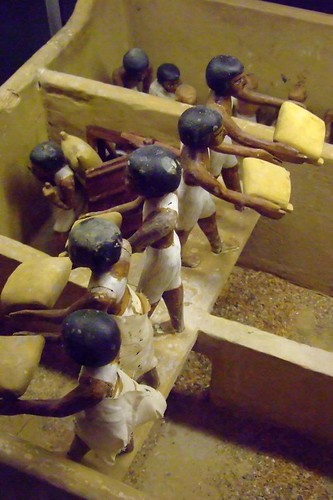
Then, on Saturday, I saw a little model granary sent along with the Egyptian dead to ensure the provision of food in the next life. And those ancient villains and I became friends of a sort.

Our friendship is an unlikely one. Besides their bad guy reputation in my religious tradition, Egyptians were just wrong. Right? There's nothing in the Christian faith about the need for building models to make sure we get fed in the sweet by and by. Why, I'm pretty sure there's a kitchen somewhere in that mansion on a hillside I'll inhabit one day. Unless it turns out that resources got scarce after the gold street paving project, leaving the mansions more meagerly furnished.

Then the tetradrachm (that's the ancient Egyptian coin I just googled) dropped.

We're not so different, those ancient Egyptians and us. We all imagine ourselves into the mystery that lies on the other side of death with the best images from this life we can muster. And when we're at our best, the stories we pass around about heaven are less a means of escape than a celebration of the best of this life.

Loaves of bread and shiny golden things. Rivers and houses and walls set with precious gems. All these lovely images may serve us best when they point us not only to a wonderful reality beyond this life, but to something (or even some One) that lies beneath this life, to the source of beauty and goodness itself.

For in the end, a better question than "Will things really shimmer like gold in heaven?" may be "Why do we love things that shimmer at all?" Because "Will things really shimmer?" is a fair enough question. "Why do we love them?" might be the beginning of prayer.

Tuesday, February 23, 2010

An Accidental Lent

Flaubert has just shown us Emma at the piano with Charles watching her. He says, "She struck the notes with aplomb and ran from top to bottom of the keyboard without a break. Thus shaken up, the old instrument, whose strings buzzed, could be heard at the other end of the village when the window was open, and often the bailiff's clerk, passing along the highroad, bareheaded and in list slippers, stopped to listen, his sheet of paper in his hand."

The more you look at a sentence like that, the more you can learn from it... It's always necessary to remember that the fiction writer is much less immediately concerned with grand ideas and bristling emotions than he is with putting list slippers on clerks.

- Flannery O'Connor in Mystery and Manners

On my bookshelf sits a fine paddleball game, painted in bright colors and the words "Rainbows from Heaven". It was a gift from the leaders of a young adults retreat called Vocare that Ardelle and I spoke to a few months ago.

I keep the thing around because I don't know what it's for.

Paddleball sort of has a purpose, I guess: trying to make contact with the bouncy little ball that's been affixed to the paddle by a length of rubber band. But the decoration of the paddle with a grinning sun, three colored rainbow, and requisite dove makes the thing harder to make sense of. Reconciling the campy happiness of its message with the violent, percussive nature of the game is a little odd. So I don't bother. I just do it.

Lent is often a purposeful time. We deny ourselves chocolate, hoping we'll lose weight, or coffee, hoping our jittery hands will calm. Or we take up something like serving at a soup kitchen or reading the Bible, hoping we'll become more compassionate, or more faithful, or more something.

But it also might be helpful to be unsure of what Lent is for. Flannery O'Connor believed that the worst writing has long been produced by writers who think they know what they're doing, especially writers who have a moral or an agenda they'd like to embed in a story. As she puts it, the worst writers are more concerned with "grand ideas and bristling emotions" than they are with "putting list slippers on clerks".

The plot of Madam Bovary didn't hang on the sort of slippers worn by that clerk. But the story is enduring only because Flaubert created a believable world, and cared as much about its unnecessary particulars as he did about any lesson or theme to which his novel might be reduced.

Similarly, I'm deciding not to decide about the purpose or outcome of Lent this year. Without pretending to know what they're for, I'm going to relish Lent's spare details, the litany, the noonday prayers, my coffeeless mornings and Tuesday blogs... I'm going to relish these details without asking them to mean or do anything too soon.

Leaving them a little bit free, perhaps, to mean or do things that I can't quite imagine.

Paddleball anyone?

Thursday, September 10, 2009

The Liturgical Door

It's been a while since I've blogged. Below is an article to be published next week in The Christian Century. Just to be safe, I've posted my original submission here, which was shortened and edited a bit for the publication.

I learned to install a door on an ordinary weekday in small town Arkansas. The house was a nondescript tract home, whose pinkish, mottled brick was dated before the mason finished his work. The door was an equally uninspiring metal unit from the lumberyard, to be installed at the house’s main entry. It had been delivered to the site already hinged and hung in its jamb.

In a matter of minutes, my boss, Dave, had given me all the information I would ever need to install a door. He told me how to make sure the studs on the hinge side of the opening were plumb in two directions, tacking up shims to correct for the framers’ hurry. He explained to me that a push on a corner in one direction would effect a movement in another. All I had to do was fill the framed opening with the door, making all things plumb and flush.

When he returned an hour and a half later, Dave was clearly, but politely, surprised that I was still struggling at my task. I had all the information I needed, but when put into practice that seemingly rigid object behaved like a balloon in my inexperienced hands. A push to its here bulged its there wildly. A butterfly of a shim tap created a whirlwind of chaos in a faraway place on the door.

Dave stepped in, gave a few knowing bumps and shoves, and in a matter of moments, all was right with the door.

There are different kinds and loci of knowing. And the goal of any apprenticeship is an accumulation of knowledge in the hands. No explanation is required other than the properly fit thing: the flush door, the mitered corner. Things visibly meet and right.

Some traditions place a great deal of value on religious information. Accordingly, the Christian faith is measured in a quick tally of doctrinal positions. Real Christians are called ‘believers’ perhaps, a term that suggests the possession of some essential and accurate information about God.

I grew up in one such tradition. Our information happened to come from methods and sources embraced by the right end of the religious spectrum. The left had and has their methods and sources as well.

But even though I couldn’t have said so at the time, a hunch was growing that my knowledge of the faith wasn’t making its way into some terribly important parts of my self. I still felt like that clumsy apprentice with plenty of information in his head, but whose hands remained ignorant and inadequate.

Liturgical worship assumes that bodies must learn too. It’s not enough to fill one’s mind with an orthodox collection of facts—whether established by pope, prophet, or sacred text. Something happens, something is communicated to and into our selves when we bow, stand, kneel, sing, and process together. Colors and smells and even the arrangement of furniture deliver information to different parts of our selves.

So might we begin to imagine our hands, knees, noses, bellies, our bodies as curious? As seeking? As wanting to know something of the mystery of God as surely as our minds do?

When Christians read the insistence in James that “faith without works is dead”, we tend to understand works as expressions of faith. Faith is an interior reality that can and should make its way to the surface of a life. But what if more attention were paid to the way that “works”, the concrete actions of bodies in the world, infect faith with life? What if we understood the work we do—thinking here of liturgy, “the work of the people”—in terms of formation more than expression?

Even conspicuously liturgical traditions can ignore or deny liturgy as a means of formation. Gestures and movements are easily employed as secret handshakes, signs that someone carries the right information about how to worship. “Did you see that guy make (or fail to make) the sign of the cross at the Benedictus Qui Venit? Clearly he’s not one of us,” the thinking goes, whether we think the response all the way into words or not.

But more and more people are coming into church blessedly oblivious to the right liturgical answers once agreed upon in their high, low, evangelical, Anglo-Catholic, or broad church congregations. And these people bear a particular gift to the gathered assembly: They simply haven’t learned to read the signals.

The newness of the gestures and motions, perhaps even the clumsiness with which they are first employed reminds us all that sometimes grace is out at our fingertips first. It may take time and motion to settle inward.

Liturgical converts are naturally open to the possibility that liturgy isn’t meant to express who we are so much as it’s meant to transform who we are. Liturgical actions need not function as encoded messages, meant to mark out theological territory nor are they flashy vehicles meant to transport speakable doctrines to our heads. Such actions change us, because we are people who not only think thoughts about God, but who live and move and have our being in God. And the movement of our bodies is an irreducible, irreplacable way of knowing.

So maybe the liturgy is helpfully thought of as a door. Not as a portal to be walked through into someplace else. But a door like the one I struggled with all those years ago as a carpenter’s apprentice. For the transformation worked or wreaked by the liturgy is bodily. We lean into the mystery here and discover something moves there, our bodies learning, learning all the while. Maybe the liturgy itself is the sturdy thing my body is meant to struggle with until its wisdom makes its way into my hands, into my belly, into my bones.
Tuesday, July 28, 2009

Bearded and Blessed

A disclaimer: There's a decent chance that the story this blog opens with will find its way into a sermon one day. Sorry, Christ Church parishioners, but, as you know, this is the strange stuff I dig. Just nod knowingly if and when it shows up again.

Even among the stories of 16th century iconoclasm, what happened at the Danish church of Holstebro is uniquely bizarre. As the ideals of the emerging Reformation took hold, pietists worshiping at Holstebro found a painting of the Dormition of the Blessed Virgin Mary in their church suddenly incongruent with, even offensive to their Lutheran worship sensibilities. So, with a few careful (one hopes) brush strokes, the virgin was transfigured into Jacob. She was given a beard. Conveniently, the twelve apostles did not need any corresponding alterations to take up their new identities as the patriarch’s twelve sons.

The edited painting remained unchanged until 1907, when the beard was removed and Jacob became Mary once again. Perhaps the long overdue unbending of Mary’s gender was a tragedy Marcel Duchamp intended to counter by providing the Mona Lisa with a goatee twelve years later.

The obvious question first asked about the project of the 16th century proto-Dadaists is “Who would do such a thing?” But here’s another: “What did such a thing do to the people who prayed near it for four hundred years?”

Think about it. Sunday after Sunday, generation after generation of the Danish faithful said their prayers near a painting of a bearded Blessed Virgin. Were they changed by the experience?

I imagine some folks came to love the painting, perhaps even knowing its complicated story. Others may have been startled and excited to learn of the subversive presence of the Blessed Virgin, watching over them incognito all those strange years. The beard's erasure may have felt to them like a sacred cover blown. Maybe Mary looked more delicate and vulnerable than ever, her cheeks pale and naked as chalk. Who knows?

But even art can't go back. An old reality wasn't restored, because the restored gaze of the original image fell on a different generation of people, with different expectations, with a different set of experiences including the experience of an unshaven Mary named Jacob.

The strange story is one more reminder that meaning happens in the moment. Nothing is retrieved from history intact or unscathed.

So consider this the next time you retrieve a story from the Bible. Do we really want our art, our scriptures, our religion to stay put? Are they stable things to be preserved, or restored, or returned to? Or to they speak to us even as they are being scarred, defaced, and deformed by history and the hands of folks like us?

Tuesday, June 23, 2009

Permanence

So much for permanence. The house is gone. The driveway that wandered south where Holly Place turned north remains. But the asphalt is going fast to gravel and the gravel is going fast to grass. The house is gone entirely.

The porch where Grandpa sat in his aluminum lawn chair and tended the ice cream machine is gone. The great spirea bush outside the bedroom window is gone. I didn't venture into the woods to look for the rope swing we would ride out into the air as the hillside fell away below our kicking legs. If it's not gone, it's going.

Mark Strand's lines come to mind:

When I walk
I part the air
and always
the air moves in
to fill the spaces
where my body's been.

We all have reasons
for moving.
I move
to keep things whole.

- from "Keeping Things Whole"

It was as if the air had moved in to fill the spaces where the house had been. And perhaps, in the process, things were kept whole. Strangely, I had a sense that they were.

It helped, no doubt, that the house wasn't much in itself. A clumsy addition and the awkward tie in of the house roof to the garage suggested that this building was not evolving into a higher form. It was time for a clean lot and a fresh start.

Which helped orient me to the real holiness I sensed or supplied on the day of my visit a few weeks ago. The fact that the house was gone made plain to me that the sacred lived not in a building or even in a persons, but in the interractions and exchanges that were always happening in some present.

The pleasure of peach ice cream was far more complex than it's sweetness on the tongue. The latent goodness in the soupy ingredients, the slow grinding of the motor and its increasing effort as the stuff got thicker as it froze, the lingering stickiness on our fingers all contributed to the pleasure that was passing through our lives on those fine summer evenings. Goodness was always in motion through our lives and to stop it would be to kill it. Goodness preserved would be like a butterfly stuck through with a pin.

So it made a kind of sense that the house had to pass away too. That's how goodness, holiness, the sacred makes its way through us. It can't be preserved alive.

I think St Paul's famous insistence that most things pass away but faith, hope and love abide was meant for a world in which houses fall down and wildness creeps back in even before memories have much faded. Before we get too sentimental and nostalgic we should also note that the dark side of this truth is the promise that the sins of the fathers are visited on the third and fourth generations. But Paul's good news is that faith, hope, and love will outlive even our sins.

The house is gone but something endures. Something subtler than memories. Something of that strange and lovely group of porch dwellers, whose bodies left us only a little more slowly than the melting ice cream of a muggy August evening. Something abides. In me. In my children. Perhaps somehow even in the abandoned lot that the persistent wildness of the earth is making its own once again.

Something, beginning with just the air, has filled the spaces where that house, where those bodies had been. They have moved, but things are kept somehow whole.

Tuesday, June 9, 2009

Liturgy's Allure

In the Hitchhiker's Guide to the Galaxy the truth about laboratory mice is made plain. What the book's hero, Ford Prefect, discovers (during the adventures that follow the unsettling news that the Earth is to be razed to make way for an interstellar highway) is that the world's laboratory mice have been conducting an experiment on humans all these years.

We were the folks in the lab coats holding the clipboards. But the mice were in control, researching how humans might respond if they were to run around in little mazes, and ring bells. (Below is the cartoon in the New Yorker's most recent caption contest. Submit your entry if you find such contests alluring.)

Michael Pollan took this notion a step further in complete seriousness when he suggested that apple trees and tulips and marijuana plants and potatoes all get us to do the work necessary for their survival. They entice us into being their slaves through our desires for sweetness and beauty and intoxication and (the potato isn't so obvious) control (see his Botany of Desire).

We're not used to thinking about being allured into doing what we do and being who we are. And ever since Eden we've been conditioned to be suspect of and resist the alluring fruit or woman or handmade Waterford bicycle fitted with Campagnolo Record components throughout.

But it seems to me that we're always responding either to duty or allure. Both duty and allure prod us or lift us out of complacency.

I think my own movement into a liturgical tradition had something to do with an attempt to right a religious worldview tipped heavily towards duty. Worshiping among robes and chalices and soprano descants was powerfully alluring to me. And more importantly, I felt allured but not manipulated.

Kneeling, bowing, standing, making the sign of the cross, all of these movements and gestures were drawing me into something happening among that little crowd of peculiar Christians at Grace Episcopal Church on Mt. Olive Street in Siloam Springs.

Now Episcopalians can be a fairly heady group--sometimes pretentiously so, I'd say. To our credit, I think, a broad swath of belief and opinion is tolerated and voiced. What we don't tolerate so well are folks who don't think toleration is the chief virtue. This is to our detriment, I think. But that's a topic for another blog.

More than the Episcopal church's supposed "open mindedness", it's the allure of liturgy that drew me in, even if I was looking for a place where my opinions were more tolerable as well.

While traditional liturgy can look mighty contrived and controlled with all those read prayers and rubrics telling everyone when to kneel, stand, or sit, at its heart liturgy is a letting go. How often do you let yourself say what you're told to say (verbatim) and assume a posture you're told to assume?

For some, joining the liturgy may be a matter of duty. The prayer book says do a cartwheel, so I will do a cartwheel. Or, most people do cartwheels at this point in the service. So I'll do jumping jacks.

But for most, I think, it is the liturgy's allure that we respond to if we respond at all. We let go of our own prerogatives for an hour, and let ourselves be drawn into something larger than ourselves.

I still find myself surprisingly moved by the sounds of the great organ at Christ Church ringing through the nave. Or by the voices of 150 people as they stand and say, "We believe in one God..." Or by the bodies of those same people as their heads bow as a flip-flopped acolyte carries a cross past their pews. For reasons I can't adequately explain, I find it all terribly alluring.

But to be alive is to be allured, isn't it? To be alive is not to be completely in control. Whether we're subjects of a grand rodentine experiment or being seduced by tulips, or apples, or potatoes (I'll leave cannabis alone, or leave it for the comments to follow), or whether we're being drawn into the drama of the liturgy, we let ourselves go a little because we sense that it's desire that draws us through life. And maybe it's desire more than duty that sends our lives towards God.

We're always responding to something's allure. Maybe living well is about deciding how and when and before which allure to let go.

Tuesday, May 26, 2009

Mercy for the War Dead

On this Memorial Day after, I commend Stanley Hauerwas's prayer "Mercy for the War-Dead", adding nothing but my own amen.
Dear Lord, at our feet lie dead Iraqis, dead Kuwaitis, dead Kurds, dead Croats, dead Slavs, dead Salvadorans, dead Americans, dead Palestinians, dead Israelis, dead Jews, dead children, dead Christians--dead, dead, dead. We ask your mercy on these war-dead sisters and brothers. We ask for the same mercy for ourselves, for our failure to be your peace, to be the end of war. Save us from the powers that capture our imagination so that we think our only alternative is war. We know we cannot will our way to peace, for when we try we end up fighting wars for peace. So compel us with your love that we might be your peace, thus bringing life to this deadly world. Amen.

- from Prayers Plainly Spoken

Thursday, May 21, 2009

A LUV is all we need

I was 16 years old and wanted a vehicle of my own in the most desperate way. And the best evidence of that desperation's intensity was the thrill that attended my uncle's call from his lumber yard one day. A customer's 1975 Chevy LUV pickup truck had broken down. And so had the customer. He'd had it with the truck and was ready to sell.

Being in retail, my uncle Stewart knew when the time was ripe make a deal. So he called me. "You need to come down and make an offer. He's talking like you might get the thing for $50." That's right. Fifty dollars. American currency.

Well, by the time I'd made it to the Lumbermart Building Supply parking lot, the price had reached $200. But not even that great and climbing sum could keep me from my first set of wheels. We closed the deal then and there.

The truck was the saddest shade of pea green and its eight years of life had been hard ones. The texture of the steel across the driver's side bore a striking resemblance to the cheeks of Keith Richards. Pitted, lumpy surfaces that also suggest travel along some pretty rough roads and more than a few trips right off into the ditch.

Lester, the lumber yard foreman, would become the lead mechanic on my project. And we set ourselves to the task of replacing the broken timing chain that had wreaked a good deal of havoc under the hood in its breaking. Eventually we found ourselves pulling the whole engine with the help of the Lumbermart forklift. And my crude training in the automechanical mysteries was underway.

This dismantling experience came to mind as I spent an evening with the EfM (Education for Ministry) group here at Christ Church last night. The EfM curriculum includes a little dismantling of the Bible and the Christian tradition. For instance, we read from the book of Deuteronomy at the eucharist service, and the EfMers would have studied the theory that the five books of Moses were not written by Moses (one clue is that he seems to narrate his own death at the end of Deuteronomy).

The process can be unsettling. What seemed like a glistening, perfect whole can suddenly rest in disarray at one's feet. It's exposed as a jumbled collection from varied sources with varied agendas and experiences that all inform how the stories were told. We might say that the book we thought of as a dignified old Bentley suddenly looks more like a 1975 Chevy LUV whose engine is dangling from a logging chain that's been looped around the tines of a forklift.

But somehow, as the illusion of the Bible as a staid, tame book fades, it becomes only more enticing and compelling to some of us. Far from seeming undone and lifeless, it looks a lot more like the unpredictable, shabby, glorious reality we all actually inhabit in this world.

The Chevy LUV sits hidden behind its own privacy fence in my parents back yard as it goes the way of the things of the earth. But my own 13 year old son is now the LUV infected one. And, yes, it seems like something almost hormonal is going on.

He's thrilled at the possibility of getting the old beast running again. He and his grandpa spent a few days this spring pulling off the valve cover, spraying WD-40 into the cylindars, loosening and lubricating the seized and rusted parts in the hope that they might move once again. And I'm convinced that these two dreamers are closer to the deep magic of the automobile than any Ferrari driver or polisher of Bugattis.

The stories of the Bible are sometimes beautiful and beautifully told. But they endure because they weren't told in order to be beautiful. The endure and continue to charge and change our lives because they come from the deepest realms of human experience, the parts of ourselves where meaning is made out of and amid the glorious mess that is life. It's a place of vibrant, enticing potential and possibility. It's the place where we're still thrilled, not in spite of, but because of the dents and dings and rust and corrosion that are signs of stories untold, barely hinted at, calling us towards their discovery.

Tuesday, May 12, 2009

Wikipedia Mundi

I'm wondering about Wikipedian faith. Not Wiccan faith. Wikipedian faith. Here's the opening paragraph of the Wikipedia page about Wikipedia:

Wikipedia is a free, multilingual encyclopedia project supported by the non-profit Wikimedia Foundation. Its name is a portmanteau of the words wiki (a technology for creating collaborative websites, from the Hawaiian word wiki, meaning 'quick') and encyclopedia. Wikipedia's 12 million articles (2.8 million in the English Wikipedia) have been written collaboratively by volunteers around the world, and almost all of its articles can be edited by anyone who can access the Wikipedia website. Launched in January 2001 by Jimmy Wales and Larry Sanger, it is currently the most popular general reference work on the Internet.

Critics of Wikipedia accuse it of systemic bias and inconsistencies, and target its policy of favoring consensus over credentials in its editorial process.

I know what you're thinking. This will be another well deserved potshot at the silliness that is Wikipedia. And since this blog usually considers things religious, it will dismiss the contemporary religious world as similarly shallow and misinformed.

But I think Wikipedia is cool. Go ahead. Go to the Wikipedia page on some topic you fancy yourself an expert about. Admit it. It's a decent encyclopedia page.

We've long heard about the increasing suspicion of old authority structures. It's a trend that's been bewailed and bemoaned ad nauseam. Civilization will unravel. Religious and moral life will disintegrate. Chaos will reign.

But maybe something else is going on. The fear that has been drummed up about this age is that when the old authorities (Popes and Presidents and Bibles and Grandparents) lose their grip on us, we're left to our own individual opinions about what is right and wrong, about what is true. But maybe that's not quite right.

Maybe there is a collective wisdom at work. A Wikipedia Mundi, you might say.

Now this sounds like a fairly unchristian notion--that truth happens in us. But it's not. The early fights in the Christian tradition were waged against gnosticism. And one of the main problems the church had with gnostics was with the idea that truth comes in individual portions, packaged in heaven and delivered directly from God into the minds of the enlightened few.

But there was an early instinct in Christianity towards revelation in community. Jesus said he'd keep showing up where two or three are gathered in his name. Paul helped the earliest Christians start imagining themselves as members of a body--the body of Christ, no less. Hands, Feet, eyes, ears... parts that don't make much sense or do much good without their other compliments. Parts that are foolish if they think they're the whole.

We're told that this is a godless time. That people are now their own religious authorities and organized religion is dying. But what if this is just a time in which a new kind of organization is emerging? A wikipedian organization. And what if the Christian faith, in fact, has a rich vocabulary for the notion that God, truth, meaning and the likes come to us in our collective life.

What's shifting is that the magic is no longer believed to be in the hands of the priest or the literal text of the Bible. It's in us. Not in each of us. But in all of us. And maybe this isn't a time for denominations and dioceses to disappear, but rather for them to redefine themselves, or maybe to remember what they were supposed to have been all along. Structures for collective wisdom more than individual authority.

I've heard that a commedian mocked Wikipedia early on by inserting some foolishness in a page and watching it change. But the rest of the story (off camera) was that in a matter of moments "we" had corrected the post. Something larger was at work, and that larger something pushed in the direction of truth.

Could this be like that spirit that blows where it will, but insists on blowing through us?

Tuesday, April 28, 2009

Souls and Bodies

It's 4a.m. and I don't know whether it's the rain or my back that's awakened me. The pain is smaller than a dime, just left of center. It's smaller than a dime, but so is the tip of an icepick. It's reminding me that I'm a body.

I don't know how many dime sized areas there are on my surface. A lot, even though I'm not a very big guy. Perhaps I ought to be thinking about all those comfortable spots. A better person would be. A better person would think themselves in the direction of everything well and uninjured.

But when I'm awake in the middle of the night and mindful of being a body I read the undertaker: "We are bodies in motion and at rest--there in George's master bedroom, in the gray light of the midmorning, and hour or so after his daughter found him because he didn't answer when she called this morning, and he always answers, and she always calls, so she got in the car and drove over and found him exactly as we find him here: breathless, unfettered, perfectly still, manifestly indifferent to all this hubbub."

I don't think I'm a paranoid hypochondriac. Nothing in me is worried that my little portion of all the world's pain this morning is the beginnings of swine flu, or some other dreaded force soon to lay me out like poor George. No, I don't read the undertaker because any little ache or pain brings thoughts of doom and demise.

I read the undertaker because there's no mystery greater, or no access to great mystery more reliable than the bodily ones. And sometimes it takes nothing more than a dime sized discomfort to remind me that I'm a body, and, as such, a mystery.

On Sunday Jesus ate a fish, pointed to his hands and feet, insisted that the mystery before the gaping disciples was bodily. Not ghostly. It was a body in motion that should have been at rest.

Now there is plenty in these stories to suggest that the body of Jesus that stopped breathing at about 3pm one Friday, did not simply start breathing again early Sunday morning. His friends don't recognize him. I considered this in my sermon on Sunday.

But one thing these stories suggest is that a body is enough. The mystery of God, the mystery of meaning, of why and whether we matter comes to us most powerfully not in invisible forces and spiritual powers, but in bodies. In bodies at rest, like George's, where the mystery of being is unbearably present to us, and bodies in motion, even like mine, shifting away from the dime sized annoyance in my back, just to the left, screaming to me that I'm a body. Awake. Aware. And a body just the same.

Wednesday, April 15, 2009

Church

Wendell Berry noted that once upon a time the eyes were considered the window to the soul. Now, making eye contact with a stranger on an American city sidewalk can be construed as a form of aggression.

What does this say about our souls?

The problem here, I suggest, is not urbanization, but privatization. The privatization I'm talking about isn't about the ownership of banks or health care or security forces. The problem may be the privatization of our spiritual lives.

The house where my aunt and uncle lived in Siloam Springs was on an ordinary street, lined with ranch style houses. They were built during an era in which our dwellings were gradually evolving into garages with attached houses.

Front porches were disappearing or being reduced to stoops just large enough for a couple of visitors to stand uncomfortably within, awaiting their welcome into the house. But this neighbor pushed back against the architecture of the day, not by remodeling his house, but by sitting on a lawn chair in his open garage.

It was a defiant act, really, to read his paper and drink a can of Pabst Blue Ribbon there. It at least defied what his home and his neighborhood were trying to have him do. Everything was arranged with its back to the street, the life of the household directed to the backyard, privacy-fenced and accessible only to the invited.

But since front porch culture was gone, he also seemed a little pathetic, out of place, making motions that make no sense in his present environment, like the sad pumping of the useless gills of a landed fish.

The image of the modern spiritual pilgrim is often that of the lone explorer, going it alone deep into the mystery of life. But aren't there too many of us who have struck out on our own, only to find ourselves on an aluminum chair in the garage, looking for the life on the sidewalk that is no longer?

Privatizing the spiritual life comes at a cost. Because if the eyes really are the window to the soul, I can't gain access to my own soul without you. I can't see my own eyes.

So maybe the most faithful concept of church is about making an honest-to-God front porch for the spiritual life. A place where we plop ourselves precisely because there's no telling whom we might encounter there. Or because we do know whom we're going to encounter there: a smattering of those wonderful, annoying, hypocritical, brilliant, loving, petty creatures we call human.

Maybe the soul is better accessed in all those exchanges between selves rather than within the self in isolation. Maybe going to church is simply meant to be deciding to sit for a spell on the porch once a week and see who passes by.

For some of us, somehow, it works. "And that is why," Kathleen Norris says, "when the battles rage, people hold on. They find a sufficient unity, and a rubbed raw but sufficient love, and even the presence of God."

Maybe we don't have to forgo front porch spirituality, even in the day of decks and privacy fences. But it won't help to sit alone in the garage and pretend. We have to be porch sitters, or sidewalk walkers for each other.

Wednesday, March 25, 2009

Faith and Default Settings

In the day-to-day trenches of adult life, there is actually no such thing as atheism. There is no such thing as not worshipping. Everybody worships. The only choice we get is what to worship.
- David Foster Wallace
Maybe this is how blogs are supposed to work. I publish something. Then someone else publishes a comment that includes a Hey, you ought to read this. And my next blog is about the this.

The this is David Foster Wallace's commencement address at Kenyon College from 2005 (thanks Winston Brown). Click HERE if you want to read it for yourself. The speech was (partly) about a trip to the supermarket after a long day at work.

Rather than telling all that bristling robed intelligence that great things await them, that they can achieve their dreams, that their enlightened minds will make the world a better place, David Foster Wallace said,
Anyway, you finally get to the checkout line's front, and pay for your food, and wait to get your check or card authenticated by a machine, and then get told to "Have a nice day" in a voice that is the absolute voice of death, and then you have to take your creepy flimsy plastic bags of groceries in your cart through the crowded, bumpy, littery parking lot, and try to load the bags in your car in such a way that everything doesn't fall out of the bags and roll around in the trunk on the way home, and then you have to drive all the way home through slow, heavy, SUV-intensive rush-hour traffic, etcetera, etcetera.

The point is that petty, frustrating crap like this is exactly where the work of choosing comes in.
The startling thing about these lines is that they could be just as appropriately delivered to dropouts and misfits in a court ordered anger management group. Life is about choosing. And whether you're graduating from an elite private school or teetering on the edge of society, what we choose to worship matters. The ultimate choice becomes whether to worship something or someone out beyond myself or to live as "lord of [my] own tiny skull sized kingdom, alone at the center of creation."

Learning how not to end up alone and angry in the checkout line is what life and religion are about. It's as true in the Heights as it is in the 'hood. If all we have to worship is our selves, we'll live in one hell of a lonely place.

Not, perhaps, what the bright young graduates at Kenyon were expecting. But we all have to come to terms with the checkout line self. That familiar self there under the soul sapping fluorescent lights, among the soul sapped shoppers, among all those annoyingly other people, where everyone and everything is in my way.

There I find my basic default setting. It's my way that matters. Why can't everyone else get out of it?

But the good news is that we do get to choose. We get to choose whether or not to live like it's only my way that matters. And so I'm a Christian. Maybe this seems like a flimsy argument for religion. Maybe you're still hoping for 7 irrefutable facts that will pin you down and show you the light, or convince everyone else of the light by which you see. But I don't think there's a single airtight argument for the truth of the Christian faith. I'm less and less sure there's a single airtight argument for anything. And even if there were, we'd still have to choose. Ultimately I'm Christian because I find the perspective Jesus offered as compelling and life giving.

Faith is about stepping out into a perspective beyond the confines of my default setting. It's about giving up the small kingdom of my own skull and getting the whole world in return. The whole wondrous world of shopping cart clatter and traffic, of the shuffling old and the spastic young.

And maybe what I get first, when I override my default settings for even a moment, is simply that other soul on the other side of this table, just beyond my own cup of coffee, telling me who she is and why she's happy or sad or angry or bored and what the world looks like from a perspective beyond that of my own head.

Mine's an awfully small kingdom to give up for even just that.

Saturday, March 14, 2009

The Daily Prophet

As they used to say on Monty Python's Flying Circus, "And now for something completely different..."

In other words, this blog isn't like anything I've ever written here.

When we moved to Little Rock from Virginia, Kate, then 5, asked, "Can we get one of those televisions that get channels?" So we plugged in the rabbit ears to our handmedown RCA. The few and often fuzzy channels we got were more than we'd ever had access to. But they obviously din't include Comedy Central.

After hearing about Jon Stewart's recent grilling of a CNBC commentator, I found the show on the internet. That show got this blog going. (Click here to watch it. Warning: it contains some thinly bleeped profanity.)

I think this was a prophetic moment.

It's news to most people that the Bible talks relatively little about sex, or what we call "family values". And most of the stories and teachings about sex and families would be scandalous to the folks who would present a middle class white Protestant American family from 1952 as the image of biblical perfection.

As I mentioned in a sermon on Sunday, what the Bible does talk a lot about is money and economics. Ingrained in the Torah, the Law, is a deep suspicion of the accumulation of too much wealth in the hands of too few. And a deep suspicion of making money just by having money. Charging interest was forbidden. Debts were forgiven every seven years. Property (which tends to gravitate towards a few) was to be redistributed every 50 years. The prophets repeat these warnings, more in the tenor of Jon Stewart. And my hunch is that the profanity was bleeped out of Isaiah as well.

Mr. Stewart's rage was towards managers and commentators like Jim Cramer who was caught on tape admitting that he and others in his business manipulated stock prices in order to make money. Piles of money. Some traders were just doing their jobs. But some were playing games with other people's money. Money earned by the real work of schoolteachers and electricians and business owners and all kinds of people whose wealth came from their work.

Jim Cramer advised people that a stock price might have nothing to do with the soundness of a company. It's not about whether a useful service or good work is provided. Buy a stock only if you think tomorrow somebody else will be convinced to pay more for it. It's wealth without work, unless manipulating stock prices by a hedge fund manager passes for work.

The point of this tirade is that it doesn't, or it shouldn't.

The new state lottery is something that can raise a lot of moral indignation on both sides. Some people have scruples about gambling. Some people say it's a way to fund scholarships in which people can choose freely whether or not to participate. But my concern is about the increasing notion that wealth comes out of nowhere. Which is precisely the myth promoted by the likes of Jim Cramer.

Long ago we started seeing ourselves primarily as consumers rather than producers. At what point will our economy seem to be a lottery to most of us, having almost nothing to do with what we each actually have to offer? When will we have lost the connection entirely between our work and our wealth?

The most important moral formation that goes on in our lives is not the formation that makes us say no when tempted to start a Ponzi scheme. Few of us will ever be so tempted. More important is the formation that cares about the consequences of our work and our wealth on other people. Moral formation is not about knowing the boundaries of the law (see "Mount, Sermon on the" by Jesus), or knowing allowable ways to make money in a market. Moral formation means learning in ever deepening ways that our lives and our choices matter to one another and giving all of those ways our attention.

Moral formation means putting away the convenient illusion (at least until now) that the free market will tell us what is good, and reviving the responsibility we have for imposing goodness on our markets in every exchange that we make.

Here ends the rant. Next week's topic: Something nicer.

Tuesday, March 3, 2009

Hospitality

I had seen her on Markham Street on my way to work a couple of times. She was hard to miss among the bizarre confluence of colors and patterns, the hats and skirts and beads that she had wrapped herself within.

She was even harder to miss on the front row of the Christ Episcopal Church nave. There she settled in, fully regaled not only with gowns and bags, but with a bright red bear. Throughout the service that bear was lifted up, perched on her head, and occasionally turned around so that the rest of the congregation might benefit from the message of love it bore on its belly.

I'll not pretend that my thoughts were only charitable. I'll not pretend that I thought only of the welcome to the displaced stranger Christ commanded of us. Probably the closest thing to a Christian response that stirred around in me was, "I wonder what it's like to be her."

What visions swim before or within her eyes that cause her to clap her hands, pleased with the sharp sounds bouncing around all that silent stone? What did the brass cross above the font bear or reflect or cry out to her? Something asked her to lift the stuffed red animal up in an offering gesture and to wave her hands and to stand while the rest of us sat. But what was that something, and how did it ask, and why?

I wonder what it's like to be her.

Such curiosity isn't always charitable. But could it contain or become the beginnings of hospitality?

Hospitality is fundamental to the Benedictine Rule of Life. But the practice of hospitality is meant to arise less out of obligation than expectation. It's that Christian anticipation of God's arrival into our lives through the life of the stranger that makes hospitality an avenue to the divine.

Ironically, religious fervor even among Christians is often marked by a deep suspicion of the 'other'. Suspicion and distrust fills all the space where one might wonder what it's like to be that street person or that gay person or that conservative person or that (fill in the uncomfortably other of your choice).

But maybe God has scattered the seeds of new life indiscriminately. Even in the seemingly perverse curiosity of our gawking selves we might find enough empathy to be tended and nurtured into the lifegiving expectation that God may be coming to us even through this strange one.

Kathleen Norris tells the story of an old aquaintance showing up at her door needing hospitality one night. She and her husband were in something of a crisis. He had fallen into a fit of depression, and Ms. Norris found it contagious. But the truth soon came clear that what these two people needed was to be hospitable that night. Not for the sake of the stranger, but for their own sakes. They needed to look up and out and away from their own lives for a moment, just long enough to break them open to a little grace.

Maybe that's what hospitality has always been for. While we know that there are people in this world whose very survival depends on the hospitality of others, what if the Christian practice of hospitality begins with my very own need to offer welcome to someone who is not myself.

Some days I need more than a nudge to be reminded of this truth. I need more than a whisper. Maybe some days I need the strangest of strangers to walk to the front row of my life and plop down, wave her arms, clap her hands, lift her red bear in the air. Reminding me of how bland and colorless God's world would be if it were populated by nothing but me. Opening up, I hope, enough hospitality to receive a little of that color, a little of that grace for myself.

Thursday, February 26, 2009

Ash Wednesday

Most buildings are made by a process of addition. Stones or timbers are stacked. Maybe the walls are assembled or poured into forms on the ground and then tipped up. Shingles or tiles or sheets of tin are fastened on top. And the built thing stands where once there was nothing.

But buildings can also be made by a process of taking away.

About 1700 years ago people in Southern Asia began sculpting temples out of living rock. Rather than quarrying stones and arranging them into buildings they just started chiseling away.

Their work was more revelation than construction. The towers and columns and intricate statues had been quietly present in the hillsides all along, until these builders, perhaps the greatest the human race has known, just chipped away all that the temple was not.

In Lent we are inclined to consider pleasures or practices that might be removed from our lives. Maybe these forty days are a clearing away of some debris. The bad habits or patterns or any of the accumulations that bury long lost parts of our selves. But Lent is not about what’s chipped away. It’s about what remains. It’s about the good and lovely thing that God wants to be exposed to us in the process.

Whether you give up ice cream or bourbon or umbrellas, whether you take up serving at a soup kitchen or teaching someone to read, our attention is often on the ice cream or the umbrellas or the act of service itself. We think it’s good to give something up or to take something up—just because. Or just because it’s hard.

But listen to Isaiah. “Is this not the fast I choose: to loose the bonds of injustice, to undo the thongs of the yoke, to let the oppressed go free?” For Isaiah the fast itself wasn’t the point. The results of fasting were meant to play out in the life of the community. Play out as justice and freedom and “…when you see the naked, to cover them, and not to hide yourself from your own kin…”

Isaiah seemed to be saying that fasting should bring an experience of kinship, or expose a kinship that was hidden. The practice was meant to connect people to one another, or make visible a connection that was present in their lives already. But
people were moving apart. Fasting employers still oppressed their workers. Quarrelling and fighting, pointing fingers and evil words persisted.

Even among good religious people. Imagine that!

We know all too well how this can happen. As soon as we begin to take our faith and our religious life seriously, we’re tempted to start making categories. There are people who fast and people who don’t. People who give things up for Lent and people who don’t. People who read their Bibles, or say their prayers, or speak in tongues and people who don’t.

We make distinctions where God meant us to make connections.

Of course we can do the same with Ash Wednesday. You and I can share a smug satisfaction about the fact that we’re here while the heathen world goes about its oblivious and sinful way. And we’ll miss the point of this day completely.

Because taking a smudge of ash on the forehead should expose for a moment the wonderful truth that the differences between you and me and the governor and the fellow who just passed out on the street corner amount to nearly nothing before God. “Remember that you are dust,” we hear, “and to dust you shall return.” Those somber old words apply to exactly everyone.

And Isaiah might say that forgetting this truth or denying this truth is a way of hiding ourselves from our own kin. It’s satisfying to reassure ourselves with all the ways we’re not like those less devout or less sober or just less interesting people. But is there really much difference between your dust and mine? Between our dust and theirs?

Confessing our mortality on Ash Wednesday is a way of chipping away almost everything away from our lives for a moment. And maybe one of the lovely things that remain is our kinship with one another before God. Admitting that we all have come from and that we all will return to the same dust means that we can’t so easily ignore or dismiss the suffering ones, or the offensive ones, or the hungry ones.
Because there’s not much difference between their dust and ours.

So whatever your practice might be this Lent, whether you give up a little food or a little time for prayer or service or whether you give up a little of your routine, consider Isaiah’s words and look beyond the practices themselves and into the lives around us.

Look beyond these practices and see the strange paradox of Lent’s abundance. The season is not about the things we chip away from our lives. It’s about what remains or emerges when we do. Things like justice and broken bonds, things that arise naturally as we remember our essential kinship with one another before God. And if we look up and out and beyond our lives perhaps Lent becomes for us not a parched place, but the rebuilt ruins and watered garden the prophet spoke of. A time in which our bones grow strong, when light breaks forth like dawn.

A copper plate from the great Kailasa stone temple bears this inscription: “…Even the architect who constructed [this temple] was struck with wonder. His heart failed him when he considered building another like it, for “how is it possible that I built this except by magic?”

Could Lent be even a time of such magic? A time to be wonderstruck at what remains when we chip away at the edges of our lives a bit? What we may find is that when we give up a little of those lives, God gives us, or God exposes to us the lives of the people around us, and shows us that these are the lives of our own kin. People of dust like us made suddenly visible to one another in this room, on these streets, in our homes, wherever we go. And maybe we’ll find that the grace of Lent is not in what’s chipped away. It’s in what remains. In all these blessed remains. Amen.